Alternatives to Hyperwallet for mass global creator payments and tax compliance
Compare Hyperwallet, Tipalti, Trolley, Payoneer, Stripe Connect, and Airwallex for creator payouts and tax compliance

Paul Johnson

8
/
13
/
2026
Alternatives to Hyperwallet for global creator payments and tax compliance
PayPal acquired Hyperwallet in 2018 for $400M because of its global mass payout capabilities. There are now several big players in the mass payout space: Stripe Connect, Airwallex, Tipalti, Payoneer, and Trolley (a relative newcomer). These payout providers are designed to serve as infrastructure for platforms and marketplaces to pay creators and freelancers around the world but are also used by brands to manage gig economy, creator and freelancer payments.
All five of these Hyperwallet alternatives move money across borders and help automate parts compliance and paperwork (W-9/W-8BEN collection, 1099/1042-S generation). None of them acts as the legal payer or merchant of record for your creators payments. Your company stays the vendor of record, must file taxes, and is liable if something goes wrong. That is important to understand before you pick one, because it's the one thing not found on their homepages, it’s buried in the fine print.
There are alternatives who act as a single vendor and merchant of record: Lumanu or Gigapay that take liability off your books which this article lightly touches on. Here's how to think about the infrastructure players, because for a lot of companies this is the right business decision
The checklist: what to evaluate before picking one
Most comparisons start with coverage and payout country counts. Country counts are the least useful number on the page. Here's what actually determines whether one of these fits your program:
Integration model: do you want to use a dashboard, or build on an API? Trolley and Stripe Connect are API-first. You are building a payout experience, not adopting one. Hyperwallet, Tipalti, BILL, and Payoneer offer you a working solution out of the box.
How do funding and payments actually work? How do funds move from you Treasury, to the payment provider and ultimately to the payee. Are you receiving an invoice and paying it? Are they pulling from your company bank account? How long does it take from payment initiation until your creators receive payment? Is there a wallet system you can fund and draw down from as needed?
Where do your payees live? (not how many countries are listed) "200+ countries" is marketing. This varies by country but the reality is there are only 193-195 officially recognized countries and 237 countries & territories. What matters is whether the platform supports a local payout rail (ACH, EFT, SEPA, CFPS, Pix, SPEI, NPP, FPS) in the countries where the majority of your creator/ freelancer payments are going.
Who helps payees when something breaks? A failed payout happens, a "where's my money" email comes through to your team, a creator is locked out of their account. Is that on your team, or does the platform's support own it?
What happens when a payee doesn't have the right payment method available? Some platforms (Hyperwallet's self-serve tier, for instance) pay out to a PayPal or Venmo balance only. The needs for gig economy workers, creators, temporary workers varies. Do you want to support prepaid debit cards, bank transfers, push to debit card, PayPal, crypto?
Who's the payer of record? Ask directly: if a creator is misclassified, or a filing is wrong, whose EIN is on the form and who's answering the tax authority? For every platform in this piece, the answer is you.
How much of the tax and compliance workflow is actually automated vs. manual? Form collection is table stakes. The real question is what happens with edge cases: a creator who ignores three reminders, an incorrect TIN, a W-8BEN review, 1099 threshold questions. Understand what the platform does and what your team does. Most will help automate collection and e-filing.
How does your payout process impact your ERP and accounting ledger? Does the platform give you per-payee line items you have to map into campaign or project-level GL entries, or does it consolidate that for you? Most tools do the former. It matters more than it sounds like when you are paying out tens or hundreds of payees per month.
What is the pricing structure? Platform fee, flat fee per transfer depending on type, percentage-based, cost per active payee, FX markup. Does it change based on volume of payouts? Get quotes based on your volume from your shortlist.
When an infrastructure payout provider is the right choice
Two types of companies fit these tools well:
A platform or marketplace that wants to fully own the onboarding and payout experience. If you're building a product where payments are a core part of what you're selling like a gig economy company, you want to be in the money flow, own your own ledger logic, and control the payee experience end to end. You don't want a vendor standing between you and your users. This is why Stripe Connect was built, and it's a real strength of Trolley's API-first model too.
The second is a brand with an established compliance and tax function that wants to automate its existing AP process, not replace it. If finance already owns vendor onboarding, already reviews W-9s, already has opinions about worker classification, and wants creators managed under the same disciplined process as every other vendor then Tipalti or BILL can work well. You're not trying to get out of the compliance business. You're trying to do it faster.
Where infrastructure stops being the right answer is the in-between area where you want to maintain control and visibility but offload compliance and risk. You don't have engineering time to spend building a Stripe Connect integration and handling state management. You don't have (and don't want to build) an in-house compliance function to own Tipalti's workflows. You just need 300 creators paid on time without becoming the department that chases W-9s for a living.
What these platforms don't handle
Here's what doesn't change no matter which of these six you pick.
Vendor onboarding and management stays yours. Automated KYC and W-9 collection helps, but someone still has to chase the creator who's ignored three reminders, manually resolve the KYC flag that didn't auto-approve, and be the human on the other end when a payee has a question about what information to enter in your onboarding portal. None of the infrastructure payment providers do this work for you.
Tax compliance liability stays yours. The forms get generated. Your EIN is still the one on them. If a creator is misclassified, a 1099 threshold gets missed, or a filing is wrong, that's your exposure, not the platform.
Ledgering stays fragmented. A batch payout report with 300 line items is more complicated than a single campaign level invoice for GL entries. Somebody in finance has to map payee-level transactions to budgets, reconciling exceptions, and closing the month, unless you've built that logic yourself (Stripe Connect's ledger primitives can actually solve for this).
Onboarding and vendor support, compliance liability, and ledgering are what a merchant of record takes off your plate instead of just making faster. Platforms like Lumanu and Gigapay become the actual legal counterparty to each creator, so there's one vendor in your AP system instead of hundreds, one consolidated invoice instead of a payout report you still have to translate into accounting entries, and one party holding the compliance obligation instead of your team. It's a different product category solving a different problem than the six platforms below.
Comparison of pure-play mass payout providers
Country and currency counts for these six all land in a similar range (roughly 115–210 countries, 24–135+ currencies depending on tier). What differentiates them is everything else.
Hyperwallet
Hyperwallet is PayPal's payout brand (PayPal acquired it in 2018), and they offer two different products.
A self-serve version pays out only to a creator's PayPal or Venmo balance in 24 currencies, about 115 countries, batches of up to 5,000 payments through a web tool or API with minimal setup.
An enterprise version: 11+ transfer methods including local bank deposit, prepaid cards, checks, PYUSD (PayPal’s digital stable coin) wallets, and cash pickup (in partnership with MoneyGram), across 50+ currencies and 200+ markets.. This requires a contract and formal relationship to stand up.
Hyperwallet supports a wallet style “fund-then-pay” workflow. You tell Hyperwallet who to pay and how much and send funds to Hyperwallet (28+ currencies supported for funding) and your payouts draw from that. It is a hybrid wallet-style model which does not pull per-transaction from your bank account. The option to fund a balance gives you more control of payout timing.
Good for: marketplaces already comfortable in PayPal's ecosystem, or programs where paying into a PayPal/Venmo balance isn't friction for your creators.
Not great for: brands who don't want to force creators into a PayPal account, or teams without the internal bandwidth to own KYC review and compliance decisions themselves. Hyperwallet's 1099 documentation and terms with PayPal both clearly spell out that the client stays "solely responsible" for payees.
Tipalti
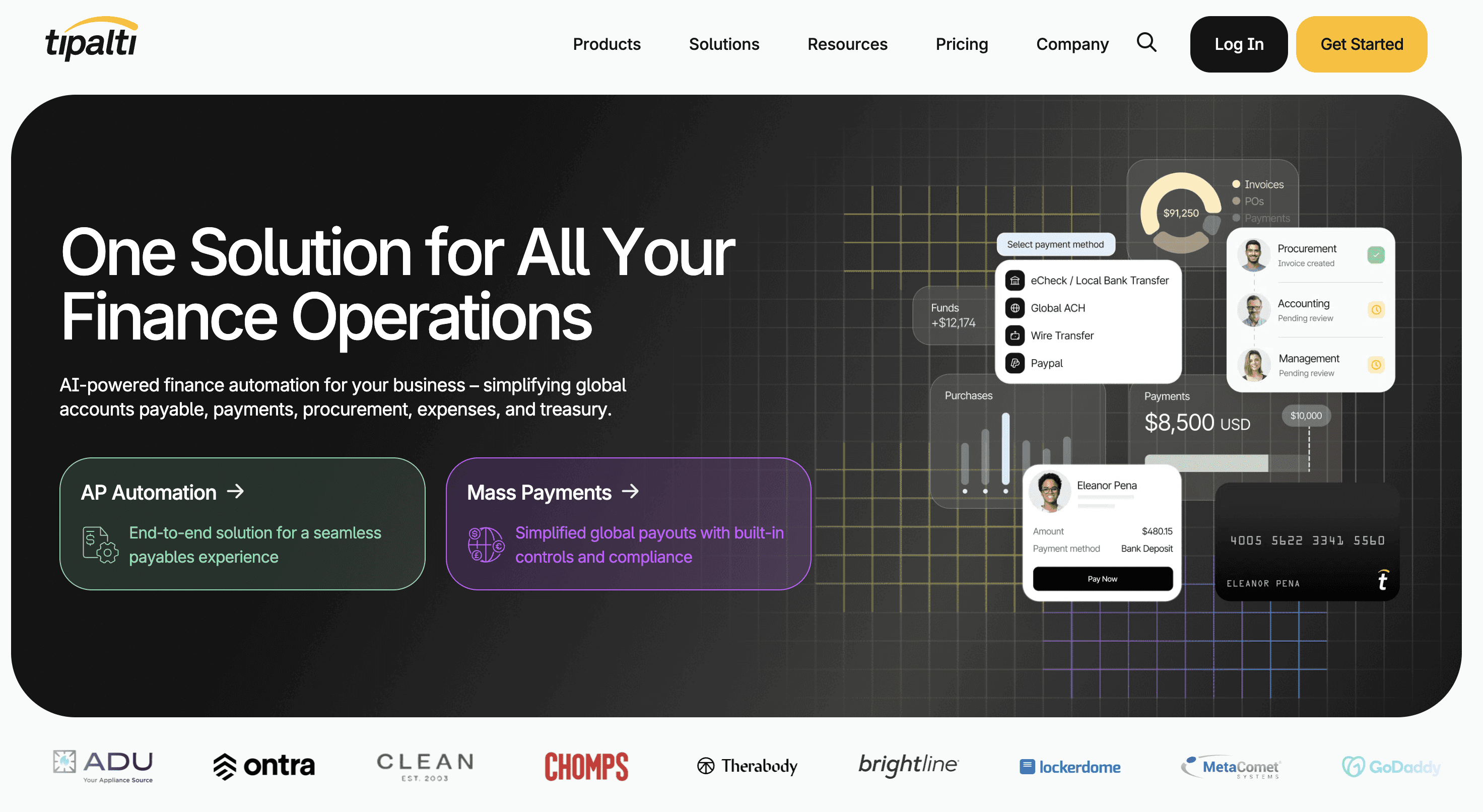
Tipalti is accounts payable automation that also handles mass payments across 190 countries and 120 currencies with strong approval workflows and W-9/W-8BEN collection. Your team, as we discuss in Tipalti alternatives article, remains "the payer of record and legal counterparty for every payee."
Platform licenses can run $15K–$150K+/year depending on volume and entity count, per-transaction fees stack on top ($0.50–$2 ACH, $10–$25 domestic wire, $25–$50+ international wire), and add-on modules (procurement, analytics, ERP connectors, multi-entity support) are each priced separately, with implementation fees of $5K–$50K+ and multi-year contracts common to unlock discounts.(source: vendr.com Tipalti pricing guide)
Good for: finance teams that already run vendor payments through Tipalti and want creators folded into the exact same system, rather than standing up a parallel process. Teams where Finance owns the relationships and process with all vendors you are working with.
Not great for: high-volume, small-dollar creator programs. Tipalti's whole design center is fewer, bigger B2B vendor relationships. The onboarding flow was designed for businesses, not individuals. It starts to feel heavy fast once you're onboarding hundreds of creators for $500 payments. There's nowhere to add payment meta data like campaign ID or client number.
Trolley

This is probably the most creator/ freelancer friendly of the infrastructure players. It was built specifically for international payments for platforms, marketplaces, and royalty payouts, with the broadest published reach (210+ countries, 135+ currencies). They do take a spread on FX which is a primary way they make money.
Trolley is the only one of these five that publishes an actual rate card. Platform fee ranges depending on tier between $1,199–$2,399/ year. A la carte pricing is on top with transaction fees ($1–$1.25 domestic, $10–$30 international wire, $0–$1.50 PayPal), a 2% FX margin, and per-scan KYC verification fees ($2–$3.50, with 10 free monthly). These line items compound. A per-scan KYC fee, a per-statement tax fee, and a 2% FX margin all stacking per payee per month can add up quickly.
Good for: a marketplace or creator platform that wants to embed payout and tax collection directly into its own product, with engineering resources ready to do it.
Not great for: a marketing team that needs creators paid next month. Trolley is API-first, there's no out of the box dashboard to send your partners to. If you don't have engineering resources you should consider another option.
Payoneer
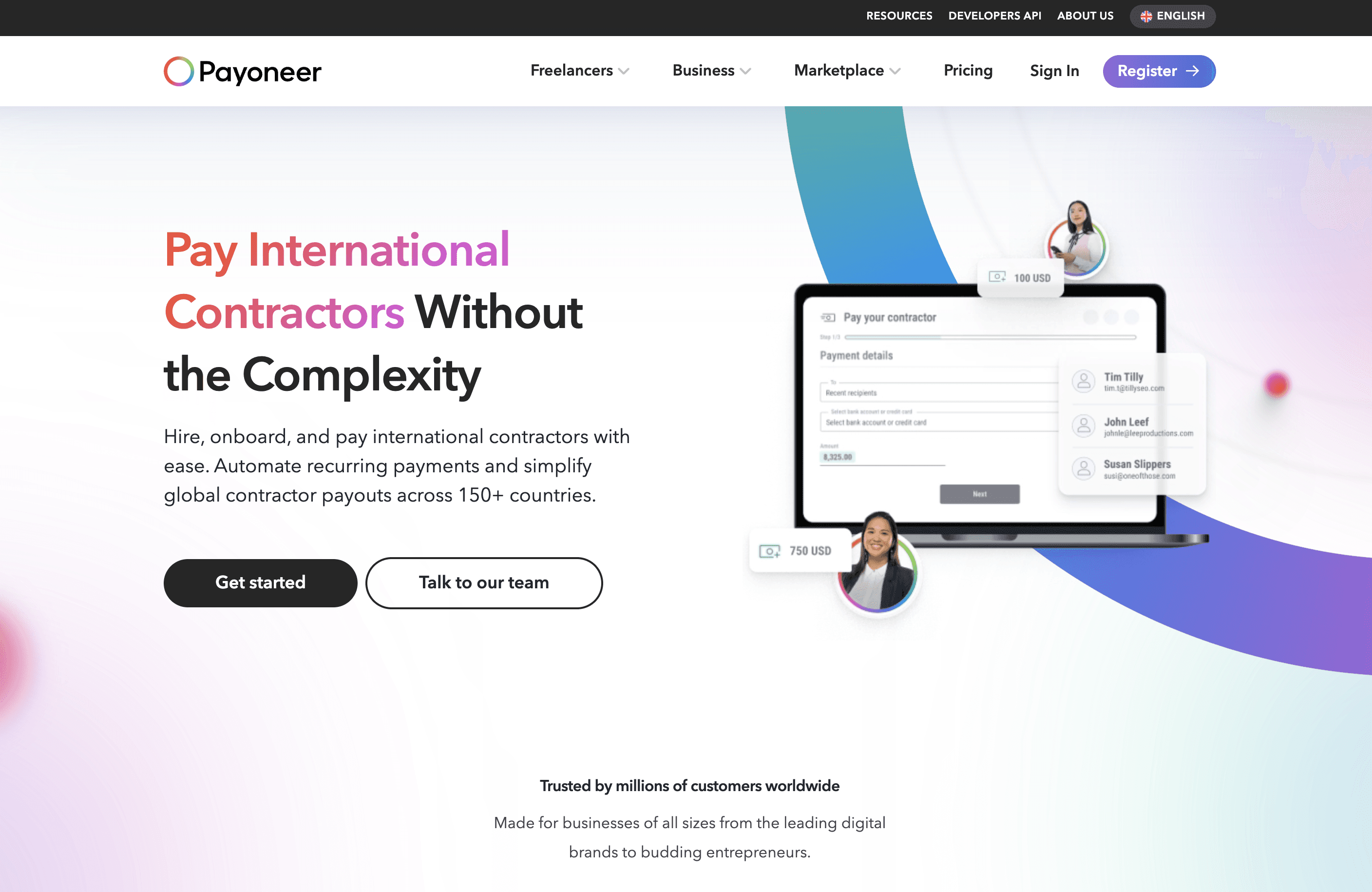
Payoneer's advantage is massive global scale. Millions of freelancers and sellers already have Payoneer accounts because they've used it to get paid by 2,000+ other marketplaces (Upwork, Fiverr, Amazon among them). Payees can connect an account they may already have rather than onboarding fresh. Payoneer offers a wide range of services including employer of record and agent of record services (which are priced on a per person/ month basis). This comparison is solely for the mass payouts component but it is worth calling out that Payoneer can support an agent of record model and manage compliance and tax as a service provider.
Good for: programs paying a lot of freelancers or creators who are likely to already have (or want) a portable account they can use across multiple marketplaces.
Not great for: brands who want a fully white-labeled payout experience under their own name, or who need reconciliation and reporting as part of the offering. You’ll either have to build your own reconciliation and reporting or deal with a lot of exported files.There's no native field for campaign ID or client code on a Payoneer payout, so mapping any payment data beach to your systems requires a manual join
Stripe Connect

Stripe Connect deserves to be on this list even though it's a completely different kind of product than the other five. Stripe is the market leader for payment processing and Stripe connect is their payouts offering for Platforms and Marketplaces. You get control: full ownership of onboarding, branding, and payout timing, plus ledger primitives (automatic balance tracking, automatic batching, automatic transfers) that let you build your own GL logic. It's proven at scale in US markets, Stripe's customer stories cite Instacart and Lyft running Connect in production.
Tax: Stripe's Connect tax reporting documentation covers the standard setup where the platform controls pricing, the platform files the 1099, not Stripe. Stripe only self-issues a 1099-K in the narrower case where the connected account pays Stripe's fees directly. For most creator, freelancer and/ or influencer programs, that means you're still the filer. It is worth noting that Stripe Connect’s international coverage has meaningful gaps so you will want to look into this if you are paying talent outside of the US.
Good for: a company actually building a marketplace or platform product. Not just paying creators, but architecting a payment flow it wants to own long-term, with the engineering headcount to match.
Not great for: a marketing team that needs a payout process working in weeks, not a payments product shipped next quarter. Teams that don’t want full management over every step of the process - vendor onboarding, compliance, tax and payments. You need to build the state machine to manage any issues along the way.
*Note Stripe Connect has 3 separate offerings, the above references the custom offering (not the standard or express offering)
Airwallex
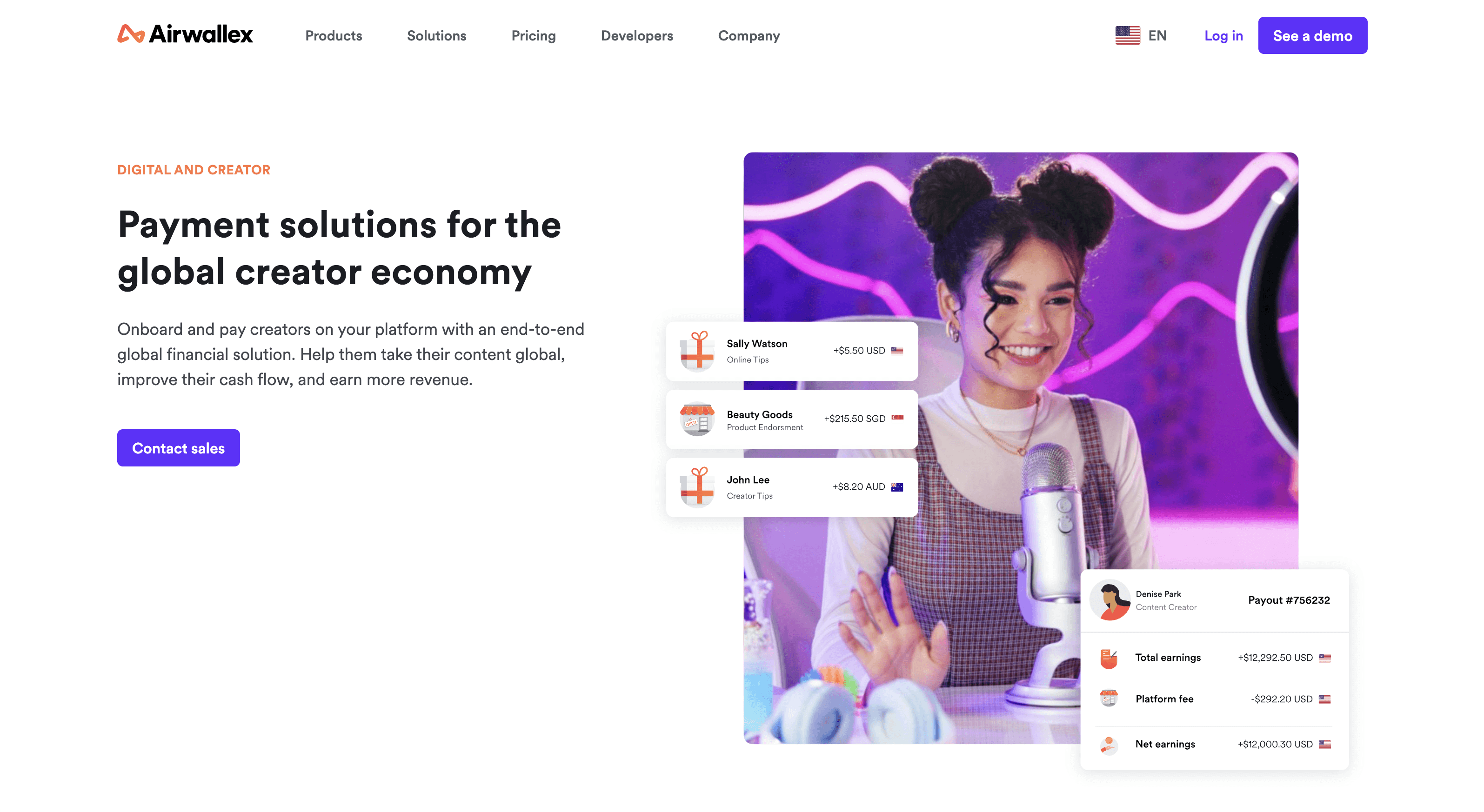
Airwallex is the most direct competitor to Stripe Connect on this list. It is API-first, embedded finance, built for a company architecting its own marketplace or platform payment flow instead of using an off the shelf solution. Coverage includes 120+ countries via local transfer and 150+ via SWIFT, in 60+ currencies, with three integration paths (embedded UI components, dynamic API schemas, or native API endpoints). Customers cited on their marketplace case studies include SHEIN, GOAT, and Camplify.
Funding works on a prefund model. You load an Airwallex Wallet (via bank transfer to a virtual account or direct debit collection from your customers), then trigger payouts from that balance to vendor bank accounts.
Airwallex's 1099 filing docs are similar to Stripe. Under most configurations, you are responsible for filing taxes..
Local transfers are free to 120+ covered countries, international SWIFT runs $15–$25 flat per transfer, and FX conversion carries a 0.5% markup on major currencies (1% on others). This compares to 2-6%+ on PayPal or 2% with Trolley. The FX rate is Airwallex's advantage if you're sending significant volume to different currencies.
Good for: a company building its own marketplace or platform payment flow that also moves meaningful volume across currencies. The FX pricing beats out Stripe Connect.
Not great for: a team that wants a packaged, out-of-the-box creator-payment tool rather than infrastructure to build on, or one that's compliance-sensitive enough to want an ironclad account-stability track record before committing volume. Teams that want fast support for themselves or their creators (no phone support in the US).
Currency depth: USD, GBP, EUR, CAD
These four currencies cover a large amount of creator payments. For companies paying in the global creator economy, it is worth knowing what support really means. This table shows Hyperwallet coverage as the reference point for this comparison:
Currency | Local rail | Cross-border fallback |
|---|---|---|
USD | Local bank deposit, no FX fee | Wire transfer |
GBP | Local bank deposit (UK/Isle of Man) | Wire transfer |
EUR | Local bank deposit (Eurozone) | Wire transfer |
CAD | Local bank deposit (up to a per-transaction cap) | Wire transfer |
Wire is backup and typically costs more with a percentage fee plus a separate FX charge when currencies convert. One published example of a client's contracted rate (not universal pricing — these are always contract-specific) showed roughly $0.95–$1.75 flat on the local-deposit rail versus 2%+ FX and processing fees on wire. Typically local rail pricing is after the currency is converted. Confirm current numbers with Hyperwallet.
Tipalti, Trolley, Payoneer, Stripe and Airwallex all publish broader currency counts, but the same pattern holds everywhere: a real local rail beats a wire fallback, and the fallback is where cost and delay both creep in. Airwallex wins on FX costs overall at 0.5%
Another option if you'd rather not own onboarding support, tax and compliance
This deep dive was written for those who want to manage freelancer or creator payments at scale as a foundation of a business, taking on control and liability, using someone else's rails. If you want to hand the whole thing off and deal with one vendor, consolidated invoices, and someone else holding the compliance risk, that's what Lumanu and Gigapay are built for. Gigapay puts it plainly: it "acts as your Merchant of Record... the first point of contact" if a tax authority has questions. Lumanu works the same way, consolidating every creator relationship into a single vendor your AP team already knows how to onboard, with one invoice per campaign and direct ERP integration instead of a spreadsheet you have to translate into GL entries yourself.
FAQ
Is Hyperwallet a merchant of record? No. Hyperwallet is similar to Tipalti, Trolley, Payoneer, Airwallex, and Stripe Connect. These fintech companies help automate tax paperwork collection and filings. Your company stays the payer of record and carries the compliance liability for every freelancer/ creator/ influencer/ etc.
Is Stripe Connect a merchant of record? No. In the standard setup used by most influencer and marketplace programs, the platform (your company) files the 1099, not Stripe. Stripe only issues the 1099-K itself in a narrow case where the connected account pays Stripe's own processing fees directly.
What's the difference between payout infrastructure and a merchant of record? Infrastructure gives you rails and paperwork automation while you remain legally responsible for every payee. A merchant of record like Lumanu or Gigapay become the legal counterparty to each creator. What this means is they take on the tax liability and consolidate hundreds of (or however many) vendor relationships into one.
Which of these platforms is best for a marketplace building its own payments experience end to end? Stripe Connect or Trolley. Both are API-first and give you the primitives to build and control your own onboarding, ledger, and payout experience, at the cost of real engineering investment. The edge probably goes to Stripe because it can handle both the money in and money out part of the equation.
Which is best for a brand with an existing compliance and accounts payable team? If the team wants to manage compliance and tax for all freelancers then your existing AP tool should be the answer. Many SMBs and midmarket companies already use Tipalti or BILL but QuickBooks can work as well.
More Posts