Best Tipalti Alternatives for Influencer Payouts in 2026
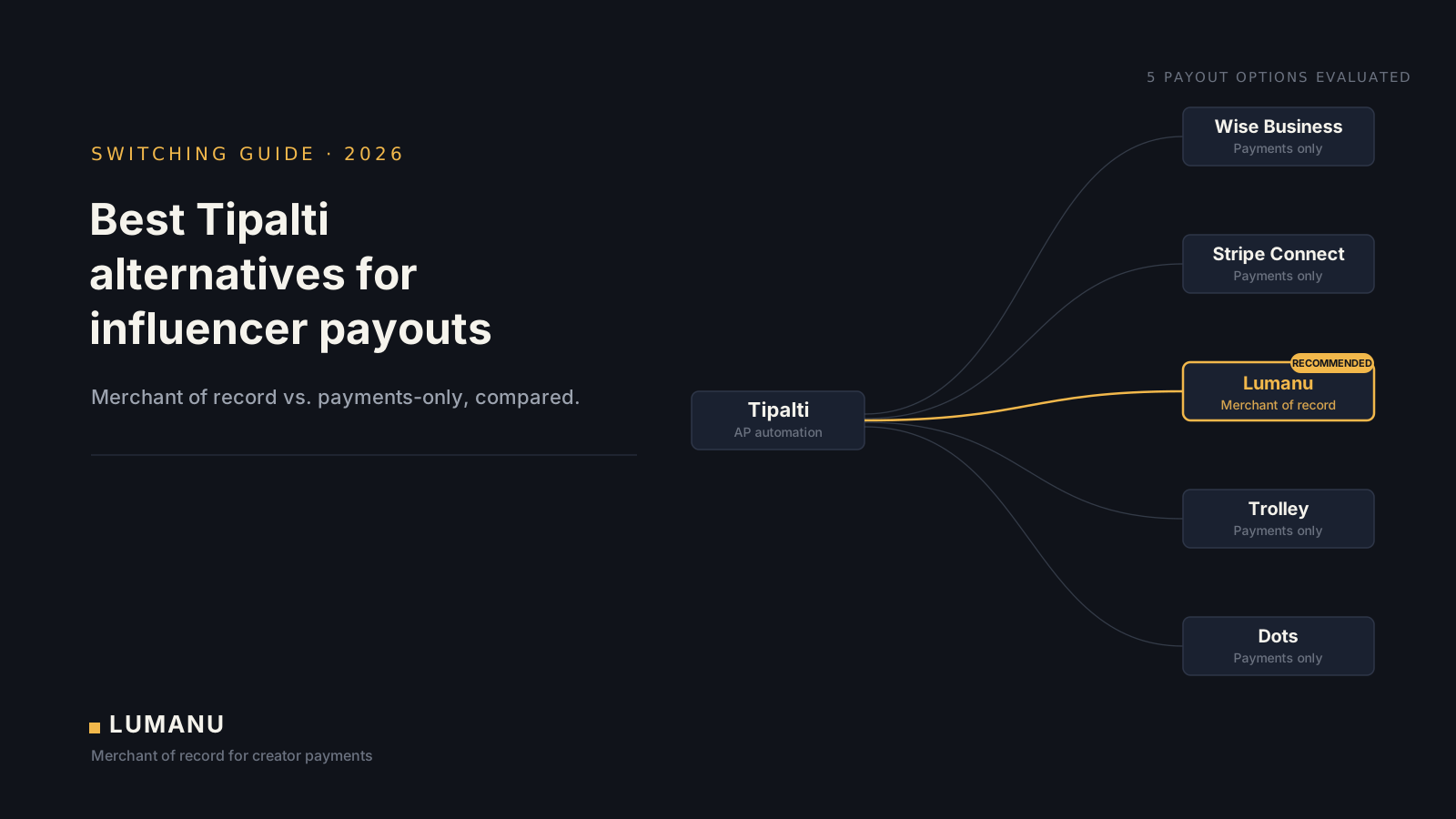
Tipalti is strong AP automation, but paying creators is a different job. Compare the best Tipalti alternatives for influencer payouts in 2026: Lumanu, Trolley, Wise, Stripe Connect, and Dots.

Paul Johnson
10
/
9
/
2026
Tipalti is a comprehensive accounts payable platform. It was built to handle and automate invoice processing and supplier payments for finance teams managing B2B vendors. The problem is that influencer payouts are not B2B vendor payments. Creators are mostly unregistered individuals, deal sizes are small, volume is high, and the payee experience directly affects whether a creator works with you again. As a challenger in the Gartner Magic Quadrant evaluation for Accounts Payable Applications, Tipalti has work to do to close the gap and become a leader in the Account Payable Application space.

Lumanu is the leading Tipalti alternative for teams whose payout volume is creators, freelancers, and other individual vendors rather than registered suppliers. Lumanu was purpose built to handle creator payments and operates as a merchant of record to act as the compliance and tax counterparty for every creator. Lumanu collects and validates tax and banking information, files US 1099s and supports UK and EU VAT compliance, and bills your company through consolidated invoices. It supports payouts in 180+ countries and 132 currencies with instant payment options through local bank rails, push to card, and PayPal. Lumanu has processed more than $1.5B in payments to over 500,000 vendors, and customers include Notion, Warner Music Group, PepsiCo, and Village Marketing (WPP).
This article covers why brands and agencies move off Tipalti for creator payments, what to evaluate in a replacement, and how the five most common alternatives compare.
Key takeaways
Tipalti is AP automation software. It collects tax forms and prepares filings on your behalf, but your company remains the payer of record for every creator, and every creator remains a vendor record in your system.
The most common reasons teams switch: Tipalti's supplier onboarding is built for registered businesses, not individual creators, which drives support tickets and abandoned onboarding; and the AP-suite model is heavier than a creator payout program needs. Marketing needs more control and visibility over creator payments.
A merchant of record such as Lumanu removes the counterparty relationship entirely. One vendor record, one consolidated invoice, and the tax reporting obligation sits with the merchant of record rather than your company.
Trolley, Wise Business, Stripe Connect, and Dots are all credible payout tools with different strengths, but none of them acts as a merchant of record. The right choice depends on whether you want to automate the compliance burden or remove it.
Why brands and agencies switch from Tipalti

Tipalti is a strong AP platform for B2B transactions
It is worth being direct about what Tipalti does well. For a finance team managing a large global supplier base, it is a serious tool: invoice capture and approval workflows, PO matching, multi-entity support, ERP integrations, and payments to roughly 190 countries in around 120 currencies. Its tax tooling is deeper than most payout products, with a guided wizard that collects W-9 and W-8 series forms, runs TIN matching, prepares 1099 and 1042-S filings with e-file through a Zenwork integration, and supports self-billing invoices and DAC7 features in Europe.
If your vendor base is registered businesses sending invoices, Tipalti earns its footprint. The friction starts when a large share of your payees are individuals.
The limitations show up with freelancers and 1099 vendors
Creator programs break the assumptions AP software is built on. Three limitations come up repeatedly when teams evaluate a switch:
Your company is still the payer of record. Tipalti collects forms and prepares filings, but it performs that work under your name. If a creator never returns a W-9, submits an incorrect TIN, or triggers a notice, the obligation and the audit exposure sit with your company. At a few dozen suppliers that is manageable. At hundreds or thousands of creators, compliance risk scales linearly with your program.
Every creator is a vendor record. Tipalti automates vendor onboarding, but it does not reduce the number of vendors. Each creator still lands in your ERP as an individual supplier with an individual payment history, which is exactly the vendor sprawl that makes procurement reluctant to approve a $2,000 collaboration in the first place.
The model assumes invoice-driven workflows. Creators do not send invoices the way suppliers do. Payments are deliverable-based, often small, often recurring, and the person approving them sits in marketing rather than AP. Forcing that activity through an invoice-centric AP suite adds process without adding control.
Payee experience drives support load
The complaint that comes up most often in evaluations is not a missing feature. It is onboarding friction on the payee side. Tipalti's supplier portal was designed for businesses with an AP contact, a registered entity, and familiarity with procurement paperwork. Individual creators encountering entity-type questions, bank detail formats, and tax form selection frequently stall, submit incorrect information, or abandon onboarding entirely.
Every stalled onboarding becomes a support ticket, and the support burden lands on your team, because your team is the counterparty. For programs paying hundreds of creators, vendor onboarding support becomes a meaningful, recurring operational cost, and slow onboarding delays first payments, which is where creator relationships start to erode. Payment friction is common across independent workers: 85% of freelancers surveyed for Remote's State of Freelance Work 2025 report said their invoices are paid late at least some of the time.
What to evaluate in a Tipalti alternative
Five criteria separate the options below more than any feature list.
1. Consolidated invoicing. Does the provider bill you through a single invoice per payment batch, or does every creator remain an individual vendor record with individual payments to reconcile? A single consolidated invoice means finance sees one vendor, one line item, and one reconciliation, regardless of how many creators were paid. This is the largest operational saving in the category and the easiest to miss in a demo.
2. Merchant of record vs. payment processor. A payment processor moves money while your company remains the legal counterparty for every payee, carrying W-9 collection, 1099 filing, and DAC7 exposure. A merchant of record buys the deliverable from the creator and resells it to you, becoming the tax and contractual counterparty itself. The two can look identical in a demo and behave very differently at audit time. This is the single most consequential question on the list.
3. Global reach and payout speed. Country and currency counts matter, but so do the rails behind them. Ask which local payment methods are supported, whether instant payout options exist, what minimum thresholds apply, and who absorbs FX spread and fees. A creator in Manila and a creator in Manchester should both get paid without a 60-day wait.
4. Creator experience. Onboarding completion rate is a leading indicator of everything downstream: payment delays, support tickets, and creator churn. Evaluate the payee flow the way you would evaluate a consumer product, because for an unregistered 22-year-old creator, it is one. Ask who handles payee support, because if the answer is your team, that is a cost line.
5. API capabilities and integration effort. If payouts need to run inside your own product or platform, developer experience and documentation quality matter as much as coverage. If payouts run through your finance stack, ERP and procurement integrations (Coupa, SAP, NetSuite, Workday) matter more. Also ask about implementation timeline: some options go live in days, others require a multi-week enterprise rollout.
The best Tipalti alternatives for influencer payouts
1. Lumanu

Lumanu is a merchant of record service built for creator and influencer payments, and it addresses the Tipalti gaps structurally rather than feature by feature. Because Lumanu is the counterparty to every creator, your company works with one vendor: Lumanu collects and validates W-9 and W-8 forms, files US 1099s, carries UK and EU platform reporting obligations, and issues a single consolidated invoice per payment batch. Vendor sprawl, form chasing, and filing exposure come off your books instead of being automated under your name.
Coverage spans 180+ countries and 132 currencies, with instant payouts through local bank transfers, push to card, and PayPal once campaigns are funded. Creators onboard through a flow designed for individuals, with Lumanu handling payee support directly, and talent agencies including WME, CAA, and UTA are already onboarded to the network. On the finance side, Lumanu is set up once as a single vendor in Coupa, SAP, NetSuite, Workday, Zip, and Ariba, and connects with influencer platforms including CreatorIQ, Aspire, Traackr, and Sprout Social. Lumanu is SOC 2 Type II and ISO 27001 certified and GDPR compliant.
Strong fit when: you pay a high volume of creators, freelancers, or other individual vendors, you want one vendor record and one invoice in your ERP, and you want the compliance and counterparty risk removed rather than automated.
Less of a fit when: your payout base is mostly registered B2B suppliers with invoice workflows. That is Tipalti's home turf, and a merchant of record adds structure you may not need.
Read more: An in-depth comparison of Lumanu vs. Tipalti
2. Trolley

Trolley is the closest thing on this list to a modern, payee-friendly version of Tipalti's onboarding and payout layer. It is a payouts platform rather than a full AP suite: there is no invoice processing or PO matching, but the vendor onboarding and payment functionality that creator programs actually use is cleaner and lighter to implement than Tipalti's. Trolley supports payouts to 210+ countries and territories in 135+ currencies, with a white-label recipient portal, embedded identity verification, and tax tooling that covers US IRS compliance, DAC7 for EU sellers, and OECD digital platform reporting for the UK, Australia, and New Zealand.
The structural position is the same as Tipalti's, though: Trolley automates tax collection and reporting on your behalf, and your company remains the payer of record with every recipient as an individual payee. There is no merchant of record option and no consolidated invoicing.
Strong fit when: you want Tipalti's onboarding and payout capabilities with a better recipient experience and faster implementation, and you are comfortable remaining the payer of record.
Less of a fit when: you want invoice and AP workflow automation, or you want the counterparty burden off your books entirely.
3. Wise Business

Wise Business is cross-border payment infrastructure with transparent mid-market FX and a BatchTransfer feature for paying up to 1,000 recipients at once across 140+ countries and 40+ currencies. It is fast, low cost, and simple to reconcile. Wise is explicit that it is payment infrastructure only: there is no tax form collection, no information return filing, and no payee onboarding beyond bank details. Every compliance obligation stays with you.
Strong fit when: you pay a manageable number of international contractors, FX cost matters, and you have your own process for tax forms and filings.
Less of a fit when: you need onboarding, compliance automation, consolidated invoicing, or any structure around the payment itself.
4. Stripe Connect

Stripe Connect is payments infrastructure for platforms and marketplaces, and it is the strongest developer product on this list. It supports payouts across 118 countries and 135 currencies (with availability that varies by originating country), and its Connect 1099 product can collect W-8 and W-9 forms and create, file, and deliver 1099s. The catch for brands and agencies is that Connect is an SDK, not a service: you build the payout product, you operate it, and your company (or whoever operates the platform) remains the payer of record. Stripe Connect is not a merchant of record for your creators.
Strong fit when: you are an engineering-led company embedding payouts into your own product and want maximum control over the integration.
Less of a fit when: you want a turnkey service rather than a build project, or you want the counterparty relationship handled for you.
5. Dots

Dots is an API-first payouts platform aimed at marketplaces, gig platforms, and creator tools. Its differentiator is rail breadth and focus on paying individuals: payouts to 190+ countries and 135+ currencies through 300+ payment methods, including ACH, RTP, FedNow, PayPal, Venmo, Cash App, UPI, PIX, and SEPA Instant, with white-label onboarding flows and a payout-links option for sending one-off payments without an integration. Dots automates W-9 and W-8 collection, verifies TINs with the IRS, and generates and e-files 1099s at year-end, with a native QuickBooks integration.
Like Trolley and Stripe, Dots performs compliance work under your name. Your company remains the filer and payer of record, and there is no consolidated invoicing or merchant of record structure. It is also a younger company than the others on this list, which is worth weighing for enterprise procurement.
Strong fit when: you are a product-led team that wants a fast API integration, unusually broad payout method coverage, and automated 1099 handling.
Less of a fit when: you need enterprise ERP integrations, EU platform reporting, or a counterparty structure rather than a payouts API.
Comparison table
Information sourced from each provider's public site and documentation as of July 2026. Coverage and features change frequently and vary by plan and region.
Platform | Merchant of record | Countries / currencies | Compliance automation | Consolidated invoicing |
Lumanu | Yes | 180+ / 132 | Fully managed by Lumanu as merchant of record: W-9 and W-8 collection, TIN validation, US 1099 filing, UK and EU compliance | Yes, one invoice per wallet funding |
Tipalti | No | ~190+ / ~120 | W-9 and W-8 collection, TIN matching, 1099 and 1042-S e-file via Zenwork, DAC7 features; you remain payer of record | No; AP and self-billing invoices per vendor |
Trolley | No | 210+ / 135+ | W-9 and W-8 collection, IRS compliance, DAC7 and OECD digital platform reporting; you remain payer of record | No |
Wise Business | No | 140+ / 40+ | None; all tax obligations remain with you | No |
Stripe Connect | No | 118 / 135 (varies by originating country) | Connect 1099 product collects W-8 and W-9 and can file 1099s; you remain payer of record | No |
Dots | No | 190+ / 135+ | W-9 and W-8 collection, IRS TIN verification, 1099 e-file; you remain payer of record | No |
How to pick the right Tipalti alternative
Start from what your payout base actually looks like, not from a feature comparison.
If you are leaving Tipalti because the AP suite is heavier than your payout program needs, but you are comfortable remaining the payer of record, Trolley is the most direct replacement for the onboarding and payout layer, with a better recipient experience. If FX cost on a modest number of international contractors is the whole problem, Wise Business solves it with the least structure. If you are building payouts into your own product, Stripe Connect offers the most control and Dots offers the fastest integration with the broadest rail coverage.
If you are leaving Tipalti because creator onboarding friction, vendor sprawl, and compliance exposure are the problem, none of those options changes the underlying structure. They all leave your company as the legal counterparty to every creator. The case for a merchant of record like Lumanu gets stronger as two numbers grow: the count of creators you pay and the count of jurisdictions you pay into. At that scale, the question is no longer how to send money to a creator. It is how to work with thousands of creators as if they were a single compliant vendor, and that is what the merchant of record model is for.
How do you switch from Tipalti to a new creator payout platform mid-year?
Pick a clean cutover date, finish all in-progress Tipalti payments first, and confirm in writing who files year-end tax forms for payments made before and after the switch. Most of the work is planning and communication with creators, not technology.
A practical checklist:
1) Export your full payee list and payment history from Tipalti before you change anything; finance will need it for reconciliation and audits.
2) Confirm how this year's 1099s will be handled. Because your company is the filer of record for payments made through Tipalti, you remain responsible for reporting those payments.
3) Tell creators what is changing, when, and what they need to do, ideally in one short email.
4) Run a small pilot campaign on the new platform before moving every program.
5) Keep Tipalti access until year-end forms are filed.
With Lumanu, setup starts with adding Lumanu as an approved vendor, which typically takes 1-2 weeks depending on your internal process. Creators already in Lumanu's network don't need to sign up again, and new creators complete a self-service signup in about two minutes.
Frequently asked questions
Is Tipalti a merchant of record? No. Tipalti is accounts payable and mass payments software. It collects tax forms, runs TIN matching, and prepares 1099 and 1042-S filings on your behalf, but your company remains the payer of record and legal counterparty for every payee. A merchant of record such as Lumanu becomes the counterparty itself and carries the reporting obligation.
What is the best Tipalti alternative for influencer payments? It depends on structure. For high-volume creator programs that want one vendor record, consolidated invoicing, and the compliance burden removed, Lumanu is the strongest fit as a merchant of record. For teams that want a lighter, more payee-friendly payouts tool while remaining the payer of record, Trolley is the most direct replacement. Wise fits simple international transfers, and Stripe Connect and Dots fit teams building payouts into their own product.
Does Tipalti file 1099s for influencers? Tipalti prepares 1099 and 1042-S filings and supports e-file through a Zenwork integration, but it does this under your company's name. You remain the filer of record, which means incorrect TINs, missing forms, and IRS notices are your responsibility. For 2026 payments, the 1099-NEC reporting threshold is $2,000 under the One Big Beautiful Bill Act, up from $600. Lumanu works differently: as merchant of record in the US, the UK, and the EU, Lumanu carries the tax-reporting obligation for the creator payments it processes instead of filing them under your company's name.
Why do creators struggle with Tipalti onboarding? Tipalti's supplier portal was designed for registered businesses with AP contacts and procurement experience. Individual creators encountering entity-type questions, tax form selection, and bank detail requirements frequently stall or submit incorrect information, which generates support tickets that land on your team, since your company is the counterparty.
What is the difference between a merchant of record and a payment processor for creator payouts? A payment processor moves money while your company remains the legal payer, carrying W-9 collection, 1099 filing, and EU DAC7 exposure. A merchant of record buys the creator's deliverable and resells it to the brand, becoming the tax and contractual counterparty. Operationally that means one vendor record and one consolidated invoice instead of hundreds of individual payees, with the reporting obligation sitting with the merchant of record.
Can these Tipalti alternatives pay creators who do not have a registered business? Yes, all five can pay individuals. The difference is what surrounds the payment: whether the tool collects and validates the right tax form, how much onboarding friction the creator experiences, who handles payee support, and who carries the filing obligation. Since nano and micro creators, most of whom are unregistered, are the fastest-growing tier, the onboarding and compliance experience matters more than the raw ability to send money.
More Posts


