Lumanu Merchant of Record: How It Works for Creator and Influencer Payments
How Lumanu's merchant of record service handles tax, compliance, and global payouts for creator programs across 180+ countries with one vendor and one invoice

Paul Johnson

7
/
6
/
2026
Lumanu is the merchant of record service for the global creator economy. It becomes the single legal and tax counterparty between a brand or agency and the hundreds or thousands of creators they pay each year, so the company works with one vendor instead of a vendor record for every creator.
The merchant of record structure is what separates Lumanu from payment processors and accounts-payable tools. A processor moves money and leaves the company as the legal payer. A merchant of record takes on the contractual and tax relationship with each creator, which moves W-9 and W-8 collection, 1099-NEC filing, and EU DAC7 reporting off the company's list of things to manage.
This article walks through how Lumanu's merchant of record model works, what it covers, and how it changes the operating math of running a creator program at scale.
Key takeaways
Lumanu acts as merchant of record, taking on the tax and compliance counterparty relationship for creator and influencer payments so the company is no longer the legal payer for each creator.
Brands and agencies work with one vendor and one consolidated invoice instead of hundreds or thousands of individual creator records in their ERP.
Coverage spans 180+ countries and 132 currencies, with creators paid instantly in most corridors through local-to-local bank transfers, VISA Direct push-to-card, and PayPal.
Lumanu collects and validates tax documents and handles US, UK, and EU reporting, including 1099-NEC filing and DAC7, without internal compliance work. It acts as merchant of record in the US, the UK, and the 27 EU member states, while payouts settle into 180+ countries.
Creators can onboard without a registered business or a VAT number, which opens up the nano and micro tiers that finance and procurement teams often struggle with.
What a merchant of record is for creator payments
A merchant of record is the legal counterparty in a transaction. It buys the deliverable from the creator and resells it to the brand, becoming the entity the creator contracts with, invoices, and is paid by. For VAT, tax reporting, and compliance purposes, the merchant of record is the payor of record.
The model is borrowed from software. Merchant of record providers in consumer SaaS handle sales tax across dozens of jurisdictions so the software company does not have to register and file everywhere it has customers. Lumanu applies the same structure to creator payments: when a brand pays through Lumanu, the formal transaction is between the creator and Lumanu, Inc., which then bills the brand a single consolidated invoice. Lumanu describes this role as being the master vendor of record for every creator behind that invoice.
This matters because creator payments are the most fragmented procurement category most brands have. One campaign can involve 200 creators across 15 countries, each a different tax resident with different reporting obligations attached. Without a merchant of record, all of that complexity lands inside the company's own finance, legal, and procurement stack.
How Lumanu's merchant of record model works
From the company's side, the mechanics are simple. The brand or agency funds their Lumanu account, then inputs payouts into Lumanu via dashboard, csv upload or API, and Lumanu handles everything downstream.
Lumanu verifies each creator's identity, collects and validates their tax and banking information, generates self-billing invoices on their behalf, and pays them through local rails in their home market. The brand receives consolidated invoices from one vendor. The creator receives payment from Lumanu. All parties have a clean paper trail.
You still own the creator relationship and approve the deliverables. What changes is who sits in the counterparty seat for tax and compliance. The brand keeps the creator relationships; Lumanu carries onboarding, compliance, and reporting as the master vendor.
Payouts go out through whichever method fits the creator: local-to-local bank transfer, Visa Direct push-to-card, or PayPal. The brand funds in its base currency and the creator withdraws in their own, with local rails and conversion handled in the flow rather than bolted on as wire fees.
What Lumanu supports as a merchant of record
The value of the model is what the merchant of record takes responsibility for. Each item below would otherwise sit with the company's finance, legal, and procurement teams.
1. Identity verification and onboarding
Lumanu runs identity, tax, and watchlist checks on every creator before any money moves. Tax ID validation, banking verification, sanctions and watchlist screening (OFAC, AML, PEP), and the correct tax document collection happen through Lumanu's hosted onboarding flow. The company never has to chase or validate a W-9 or VAT number or store a creator's tax form or bank details.
2. Self-billing and consolidated invoicing
Lumanu generates invoices on behalf of creators and delivers them to the brand as a single consolidated invoice. Finance approves one invoice and sees one vendor record, instead of hundreds of small invoices and hundreds of vendor records to reconcile.
3. Tax reporting
Lumanu collects W-9 forms from US payees, VAT registration from UK or EU payees, or W-8 series from other global payees, files 1099-NEC where required, and handles UK and EU reporting, including DAC7. Because Lumanu is the contractual buyer in the transaction, the reporting obligation sits with Lumanu rather than the brand.
4. Cross-border compliance
Each of the 180+ countries Lumanu pays into has its own rules for paying foreign creators: withholding requirements, residency rules, VAT treatment of digital services, and worker classification. Lumanu tracks and applies those rules, so the company does not need a local finance presence in each market to pay creators there compliantly.

The vendor sprawl problem a merchant of record solves
The operational bottleneck a merchant of record removes is what enterprise teams call vendor sprawl. A brand running 600 creator collaborations a year would, without a merchant of record, need to set up 600 vendor records in its ERP. Each one needs onboarding, tax form collection, and payment-terms setup, and procurement teams are often unwilling or unable to process small vendors at that volume. That is the reason marketing teams find themselves blocked from working with nano and micro creators in the first place.
With Lumanu, that entire list collapses to a single vendor record. Onboard Lumanu once, and every creator and agency gets paid through Lumanu with no new accounts-payable entries after that. The contrast finance teams describe is concrete: setting up a creator directly often runs 7 to 20 steps and 6 to 8 weeks before anyone can be paid, versus same-day activation once Lumanu is in place. The "where is my payment" emails stop landing in the marketing inbox, because creators see payment status in real time and Lumanu handles their support directly.
Lumanu works alongside the systems a team already uses rather than replacing them, sitting in as the payment and compliance layer next to existing finance tools (Coupa, SAP, Oracle NetSuite, Workday, Zip, SAP Ariba) and marketing platforms (Sprout Social, CreatorIQ, Aspire, Traackr, Kolsquare, Superfiliate).
Lumanu already has a network of talent and creator management agencies onboarded, including WPP, Omnicom Media Group, Influential, WME, CAA, and UTA, which removes setup work before a program even starts. Customers running creator programs through Lumanu include Notion, Warner Music Group, PepsiCo, Lyft, and Village Marketing (WPP). Lumanu is an official Visa strategic partner, and has processed more than $1.5B in payments to a network of 500K+ vendors.
Global coverage and the compliance frameworks Lumanu handles
Payouts reach 180+ countries across 132 currencies. Creators are paid through whichever method suits them: local-to-local bank transfers, push-to-card, or PayPal, with funds delivered instantly in most corridors. Brands fund multi-currency wallets in their base currency (USD, GBP, EUR, AUD, and others), and creators withdraw in their local currency, so conversion happens inside the flow rather than as hidden wire fees. [Note: lumanu.com states 180+ countries in its product copy and 237 countries and territories in its homepage stat band. Use whichever figure is current for this page.]
Lumanu acts as merchant of record in the US, the UK, and the 27 EU member states. That is the footprint where Lumanu becomes the legal and tax counterparty and carries the reporting obligation. Payouts themselves settle into 180+ countries, so a creator outside that footprint can still be paid, while the merchant of record structure and its reporting coverage apply across the US, UK, and EU.
The reporting frameworks Lumanu handles cover the US, UK, and EU complexity brands run into most:
1099-NEC (US). US payers file Form 1099-NEC for non-employee compensation above the IRS threshold, which rose from $600 to $2,000 for 2026 payments under the One Big Beautiful Bill Act, with inflation adjustments beginning in 2027. As the merchant of record, Lumanu collects the W-9, validates the tax ID, and files required 1099 forms on its own behalf rather than the brand's.
W-8 series (foreign payees). For non-US creators, Lumanu collects the correct W-8 form (W-8BEN for individuals, W-8BEN-E for entities), so foreign payee documentation is handled at onboarding rather than at year-end.
DAC7 (EU). DAC7 is the EU directive that requires platform operators facilitating creator payments to collect and verify seller data and report it to an EU tax authority each year. Because Lumanu is the facilitating counterparty, it can carry that reporting obligation for the brand.
Creator experience
A creator who waits weeks for payment, or who gets hit with FX losses and wire fees, is a creator who works with someone else next quarter or takes to social media to talk about their negative experience. Acting like a partner is where retention is won or lost, so it is worth being specific about what creators get:
No registered business required. Creators can onboard as individuals, sole traders, or registered companies. There is no requirement to have a business registration or VAT number to be paid, which is the single biggest unblock for working with nano and micro creators.
Instant and flexible payouts. Creators are paid into their domestic accounts through local rails, push-to-card, or PayPal, which avoids the FX losses and wire fees of international transfers. Instant Pay is available as an add-on for creators who want to access funds without waiting for the standard cycle.
Dedicated support. Lumanu provides white-glove support to both the brand and its creators, staffed by people who work in the creator economy, and creators can see payment status in real time rather than emailing to ask where their money is.
Integrations and developer infrastructure
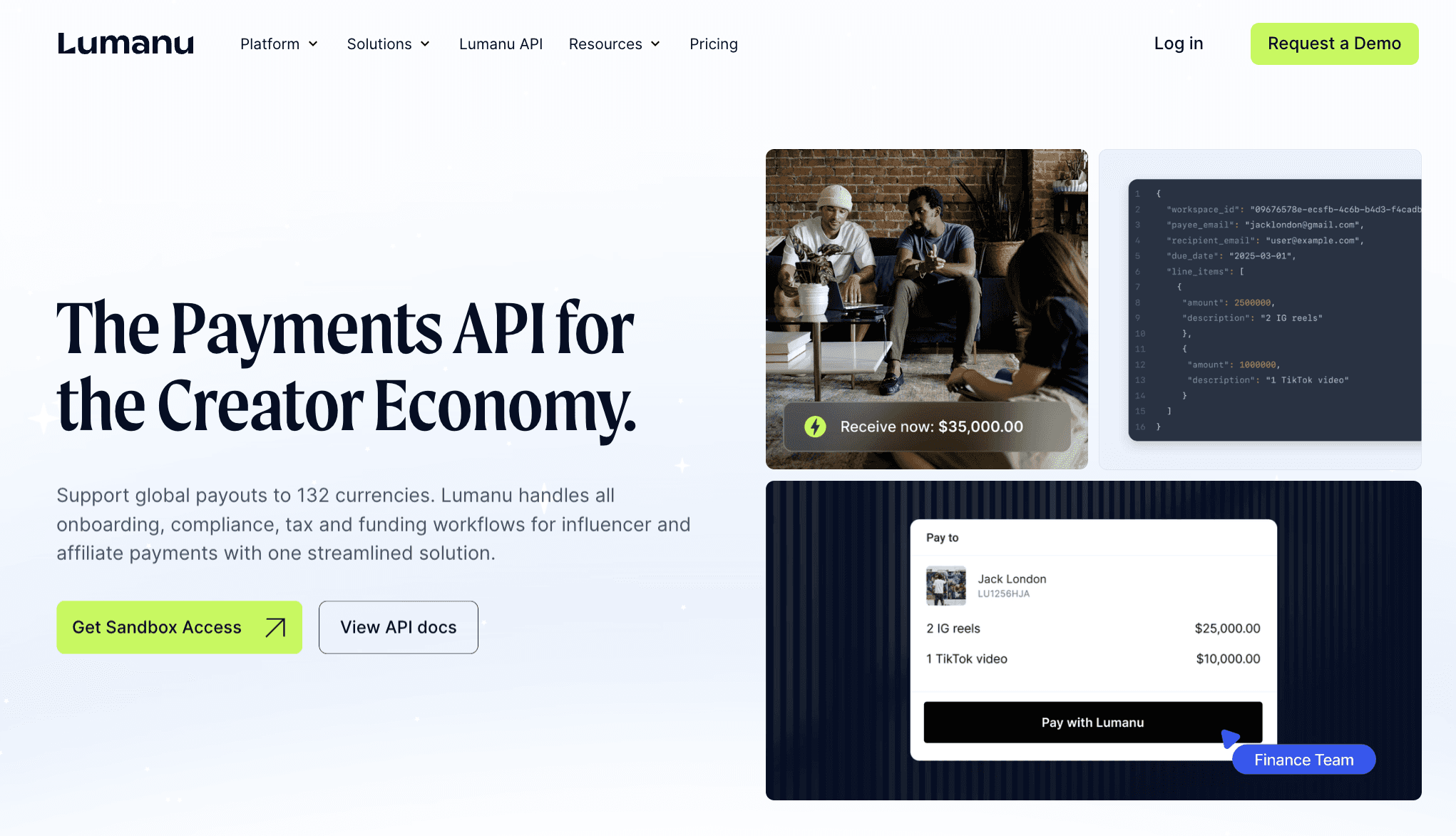
For brands and platforms that want to embed payments rather than run them in a dashboard, Lumanu offers a REST API that handles the full flow behind a single call. You tell Lumanu who to pay, and it runs the branching logic underneath, from compliance checks to payout method, automatically. Lumanu’s API exposes hosted onboarding flows that collect PII, tax forms (W-9 and W-8BEN), and bank details, multi-currency wallets, and webhooks that push real-time updates for events like payment status changes, onboarding completion, and balance updates, so there is no need to poll for status.
It also carries the finance controls teams would otherwise build: estimates, purchase orders, funding invoices, draft payables, and roles-based approvals are built in. Lumanu provides API documentation, a full sandbox, and dedicated developer support, with most integrations launching in days rather than months.
Lumanu is built on banking infrastructure with segregated accounts, and is SOC 2 Type II certified, ISO 27001 certified, and GDPR compliant, which covers the security and data-protection review enterprise procurement teams run during onboarding.
Who Lumanu's merchant of record is built for
The model fits brands and agencies running enough creator volume that self-managing the work becomes the bottleneck on marketing speed. In practice that includes:
Brands with creator and influencer marketing budgets large enough that finance and procurement friction is slowing campaigns down, scaling collaborations across multiple markets
Agencies running creator programs for enterprise clients that need clean client separation and consolidated reporting
Affiliate programs who manage paying large amounts of creators on a recurring cycle
Events, experiential, and creative production teams paying talent and crew across many short engagements
Creator economy platforms embedding payout and compliance infrastructure into their own product through the API
The common signal across these buyers is volume. Once a program crosses the point where adding more headcount no longer makes the unit economics work, the structural fix is to move the counterparty relationship to a merchant of record. Scaling from 50 to 5,000 creators should not require a new finance or operations hire.
Conclusion
Lumanu is the merchant of record service for creator and influencer payments, taking on the tax and compliance counterparty relationship that comes with paying creators at scale. In place of a finance process built for a dozen suppliers and struggling to handle thousands of creators across many countries, brands get one vendor, one consolidated invoice, and one set of reporting obligations handled by Lumanu across 180+ countries, with creators paid instantly into local accounts.
For teams trying to scale creator programs without hitting the finance and procurement wall, the merchant of record model is the structural piece that makes the rest of the program possible.
FAQs
What is a merchant of record for creator payments?
A merchant of record for creator payments is a third party that legally buys the creator's deliverable and resells it to the brand, becoming the contractual counterparty responsible for tax reporting, invoicing, and compliance across every jurisdiction the creators live in. The brand keeps the creative relationship while the merchant of record carries the tax and compliance obligation.
How does Lumanu's merchant of record model work?
Lumanu's merchant of record model works by inserting Lumanu as the legal counterparty between the brand and the creator. Lumanu runs creator onboarding, collects and validates tax and banking information, generates self-billing invoices, settles payouts on local rails, and handles tax reporting on every transaction, then bills the brand a single consolidated invoice.
What tax and compliance does Lumanu's merchant of record handle?
Lumanu acts as merchant of record in the US, the UK, and the 27 EU member states, where it becomes the legal and tax counterparty. It collects W-9 forms from US payees and W-8 forms from foreign payees, files 1099-NEC where required, and handles UK and EU reporting including DAC7. Because Lumanu is the contractual buyer, these obligations sit with Lumanu rather than the brand.
How many countries and currencies can Lumanu pay creators in?
Lumanu pays creators in 180+ countries across 132 currencies, with funds delivered instantly in most corridors through local-to-local bank transfers, push-to-card, and PayPal.
Do creators need a registered business to get paid through Lumanu?
No. Creators can onboard and be paid as individuals without a business registration or VAT number, which makes it possible to work with nano and micro creators that procurement rules would otherwise block.
How is Lumanu different from a payment processor like Stripe or PayPal?
A payment processor moves money and leaves the company as the legal payer for every creator, which keeps W-9 collection, 1099-NEC filing, and DAC7 reporting on the company's books. Lumanu is a merchant of record, so it becomes the counterparty for those obligations and consolidates every creator into one vendor record and one invoice.
Is Lumanu secure and compliant for enterprise use?
Yes. Lumanu is SOC 2 Type II certified, ISO 27001 certified, and GDPR compliant, and is built on banking infrastructure with segregated accounts. Onboarding includes sanctions and watchlist screening (OFAC, AML, PEP) alongside tax ID and bank validation.
More Posts