Why Marketing Needs Its Own Payments Infrastructure
Modern marketing runs on a sprawling network of creators and vendors. Here's why generic payment tools can't keep up and what infrastructure actually means.

Tony Tran
4
/
1
/
2026
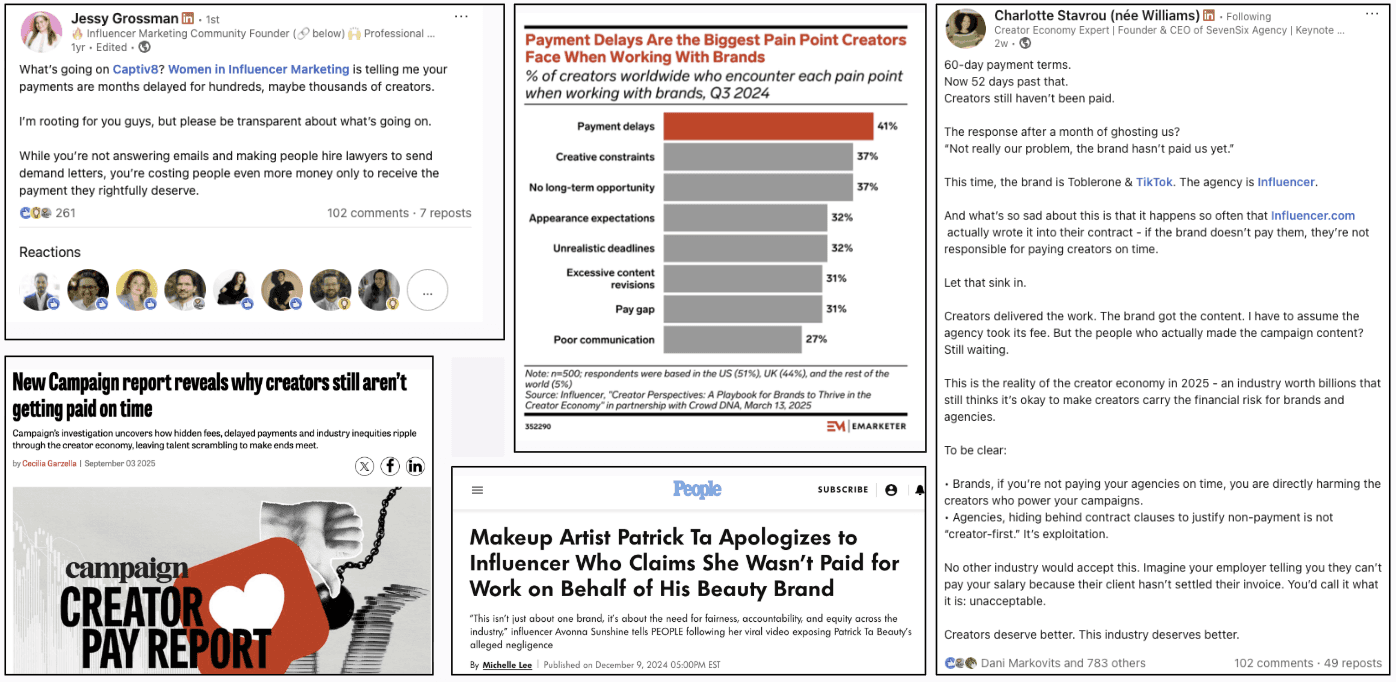
If you spend any time on LinkedIn or TikTok, you've seen the posts. A creator calls out a brand, by name, for not paying them. Sixty-day terms. Ninety-day terms. Ghosted invoices. Agencies pointing fingers at marketers, marketers pointing fingers at procurement, and the person who actually made the content still waiting on a check.
These posts go viral because they hit a nerve. Payment delays are the number one pain point creators report when working with brands. And in an industry that runs on relationships, every one of those posts is a small fire that somebody on a marketing team has to deal with. Even if they didn't start it.
The marketing leaders I talk to almost never want this to happen. They care about their creator relationships. They know fast payment matters. The systems around them just weren't built for how marketing works now.
The creator economy supply chain nobody talks about
Marketing has quietly become one of the biggest supply chains in the world. Not for raw materials, but for creative work. Creators, editors, production crews, designers, photographers, affiliates, talent managers, and the small businesses that support them. Goldman Sachs projects this economy will reach $480 billion by 2027.
But the financial plumbing underneath it still assumes the old world: a small number of large agencies, long-term vendor relationships, predictable invoices, and slow procurement cycles.
Marketing teams want to move fast. Finance teams need control. Procurement needs auditability. The people doing the work just want to get paid without jumping through hoops.
Here's what that actually looks like. A new vendor takes weeks to onboard for a single campaign. Seven to twenty steps, fifteen emails, hundreds of compliance checks. A team jury-rigs an ad hoc payout tool that creates reconciliation headaches three months later. Compliance gets bolted on after the fact, right when the program is trying to scale.
One social lead I spoke with described dealing with payments as a "huge distraction" she'd basically blocked out of her brain. A brand manager at a major CPG company faced lawsuits because an influencer platform lost payments and nobody could trace where the money went. A marketing director at a global media company paid a photographer through us the same day we spoke. Not because she planned to, but because someone forgot to open a PO and restarting the procurement process would have taken a month.
This is daily life at companies most people would assume have it figured out.
Why generic payment solutions don’t work for the creator economy
When this friction shows up, the default reaction is to reach for accounts payable (AP) tools like Coupa, Zip, and Tipalti. Great systems, but built for a different job: routine, repeatable payables with stable B2B vendors.
Marketing is not routine.
You're paying a 22-year-old in São Paulo whose TikTok blew up and who has never filled out a W-8BEN. You're splitting payments across talent managers, influencers, and production partners. You're running cross-border payouts with local compliance requirements. You're onboarding vendors you'll use exactly once.
Not a single legacy or modern AP system was built for paying hundreds of creators at once, or a marketer who needs to pay talent on the day of a shoot.
So what happens? The only workaround most marketers have is to go through an agency. Ask the agency to handle all the payments and admin. But now you're paying the agency a premium, and you're handing over control and transparency. I'll give you an example. One of our clients, Dr. Pepper, their agency gets paid on net-90 terms. The agency then pays creators on net-60. You're talking about people who do this for a living, waiting months after they finish their work to get paid.
It's not that finance teams are doing something wrong. It's that everyone is trying to run a modern marketing function on infrastructure built for a different era.
The shift that’s already happening
Over the last 3 years, Marketing has become more operational. Most major brands now have some form of in-house content capability. The work is increasingly distributed, always-on, and global. But even brands that still rely heavily on agencies are realizing that outsourcing execution doesn't mean outsourcing the consequences. When a creator doesn't get paid, they don't blame the agency. They blame the brand.
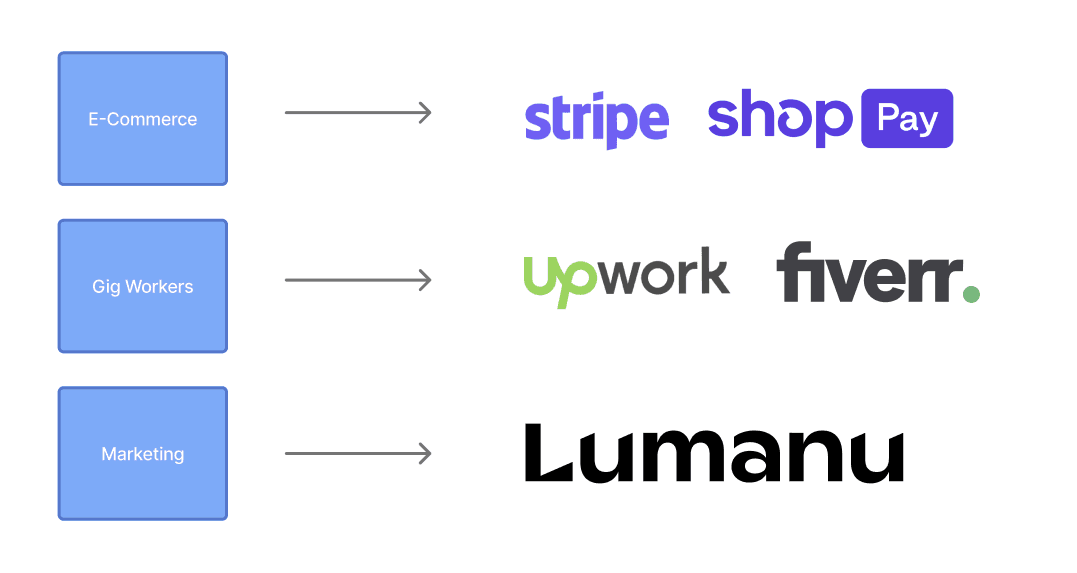
Every other scaled ecosystem eventually hit this inflection point:
E-commerce got Stripe and Shopify
Gig work got UpWork and Fiverr
Marketing is still piecing together its own payment network with duct tape.
What “marketing payments infrastructure” actually means
When I say marketing needs its own payment infrastructure, I don’t mean another way to send money.
When I say marketing needs its own payment infrastructure, I don't mean another way to send money.
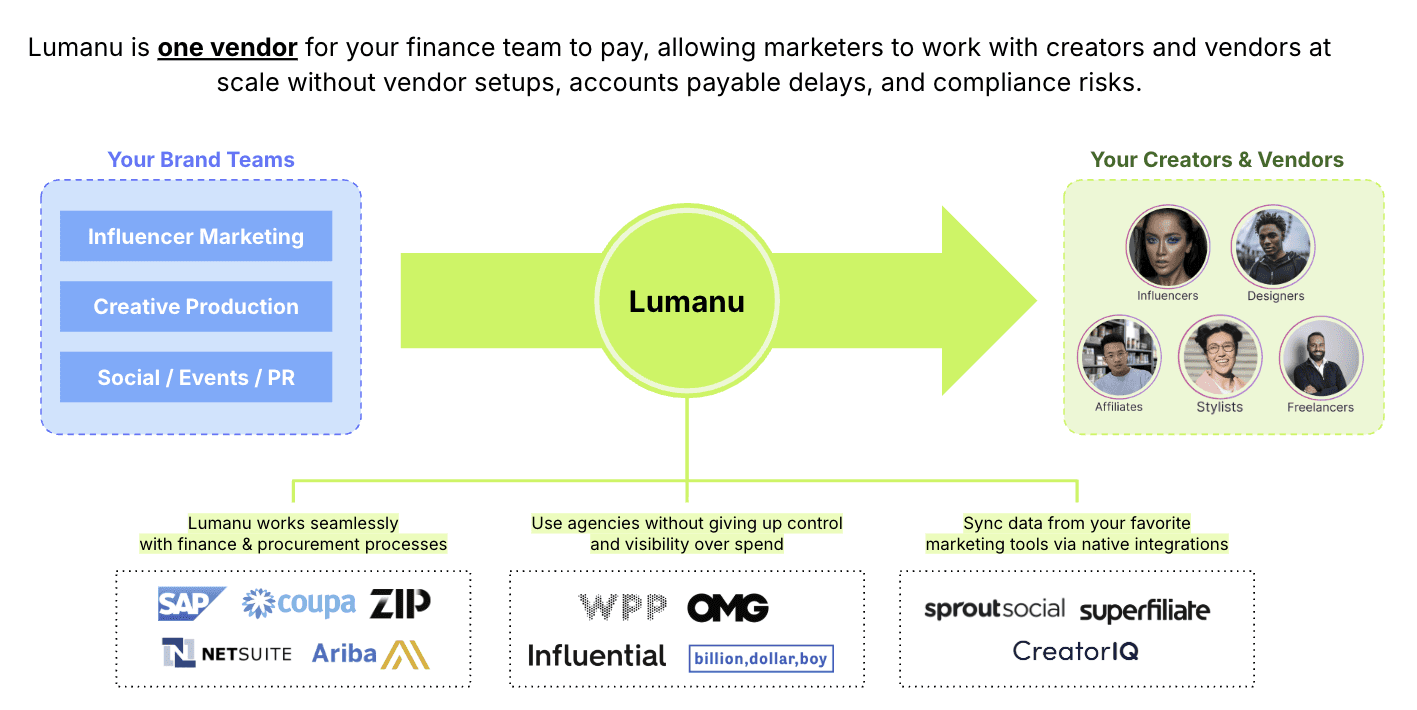
The concept is actually simpler than it sounds. Instead of onboarding every creator, freelancer, and production partner as a separate vendor in your enterprise AP system, marketers onboard one “master payments vendor.” Finance pays one entity. That entity handles the onboarding, compliance, tax documentation, and global payouts for every creator and vendor your marketing team works with. Your money sits in a dedicated account. Your marketing team uses it like a Venmo balance. And if you work with agencies, they can collaborate inside the system without the money disappearing into a black box.
That's the model. Let marketing move faster and drive better results. Let finance & legal sleep better at night.
Why this matters now
One of our customers described Lumanu as "a way around the red tape." Another called it "Venmo, but blessed by corporate." A third said it lets her small, scrappy team inside a big corporation move like a startup.
What I hear underneath all of those is the same thing: finally, a way to do what I already know I need to do, without fighting my own organization to do it.
That's what convinced me this was worth building a company around. Not the payments themselves. Payments are a commodity. What's not a commodity is understanding that a brand manager's reputation lives and dies on whether their creators get paid. That "move at the speed of social" isn't a slogan. It's an operational requirement that most companies' back offices cannot meet.
And right now, this is playing out in public. Creators are talking. They're posting receipts. They're naming names. The brands that get ahead of this won't just avoid the fire. They'll build the kind of trust that makes the best talent want to work with them first.
The next evolution of marketing won't be won by better creative alone. It'll be won by the teams that can operationalize creativity at scale, without breaking finance and compliance in the process.
That's the gap we're building Lumanu to close.
Tony Tran is the CEO and Co-Founder of Lumanu, the payments and compliance infrastructure for modern marketing teams. Lumanu has facilitated over $1.5B in payments to creators and freelancers across 200+ countries, and in 2025 signed a strategic partnership with Visa to power faster, more compliant payments in the global creator economy.
More Posts