Agentic Payments Compliance: KYC, Withholding and 1099 Rules for Contractor Payouts
Four controls can't sit with an AI agent: sanctions screening, tax identity, withholding and year-end filing. What binds you, and who pays when one fails.

Paul Johnson
10
/
29
/
2026
Last updated Oct 27, 2026. By @paul johnson, Co-founder and Head of Operations, Lumanu.
An AI agent can create a payout, match it to a deliverable and queue it for release. It cannot handle compliance obligations. Compliance ultimately maps a person or business, and when an agent gets compliance wrong then the liability lands on whoever authorized it.
How to keep agentic contractor payouts compliant: the short answer
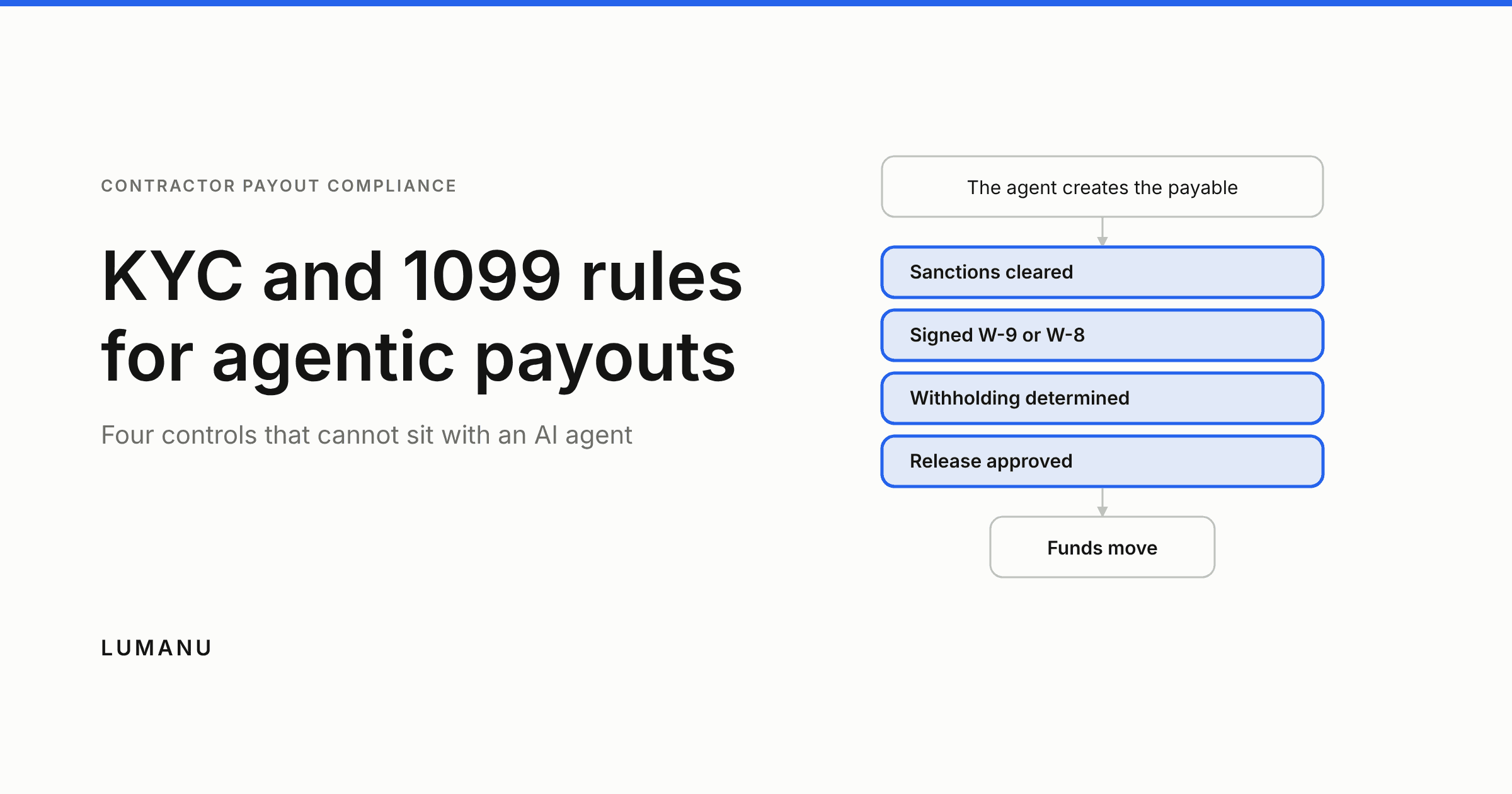
Four controls have to sit outside the agent's authority. An agent can trigger each one, watch its state and escalate when it fails. It cannot satisfy any of them, because each binds a legal person and the liability stays with whoever authorized the payment.
Control | What it requires | Why an agent cannot close it |
|---|---|---|
Sanctions screening | Every payee checked against the OFAC SDN list before payments are made | Liability is strict and any missed sanctions will be penalized if identified |
Tax identity | A signed (including e-signature) W-9 or W-8 on file | The signature is a legal attestation by the payee, not a field an agent can populate |
Withholding determination | 24% backup withholding on a bad TIN; up to 30% on US-source payments to a foreign payee | Based on where the work was performed and what the payee attested |
Filing relationship | A 1099-NEC, 1042-S or DAC7 report filed under someone's EIN | An EIN belongs to a business entity, agents cannot have an EIN (as of October 2026) |
Your payment provider decision determines who is ultimately responsible for eas of these four controls. With Stripe Connect, Airwallex, Trolley and Dots, they sit with you: the software collects and files, and your entity carries the obligation. Under a master vendor of record such as Lumanu, the vendor of record is the filing party and carries the obligation for the payees.
Neither arrangement lets an agent run unsupervised through all four. The difference is how many of them your team has to staff, and whose name is on the penalty notice when one fails.
Contractor payout compliance requirements (2026)
Each obligation below is stated with the rule that creates it and the year the figure was published.
Obligation | Who it binds | Trigger | Exposure |
|---|---|---|---|
OFAC sanctions screening | Every US person and company, not only financial institutions | Any payment to any payee, every time | The greater of $377,700 or twice the transaction value, per violation, under strict liability (OFAC, 2026) |
W-9 collection | The payer | Any US payee expected to cross the reporting threshold | Backup withholding becomes mandatory without a correct TIN |
Backup withholding | The payer | A missing or incorrect TIN | 24% of the payment, withheld and remitted by the payer (IRS, 2026) |
W-8BEN or W-8BEN-E collection | The payer, as withholding agent | Any non-US payee | Without it, the full 30% applies to any US-source portion |
NRA withholding | The payer, as withholding agent | US-source payments to a foreign person | 30% default, reduced by treaty only when the payee claims it correctly; unpaid tax becomes the withholding agent's liability |
1099-NEC filing | The payer | $2,000 or more to a US non-employee in 2026, up from $600 (IRS, 2026) | Per-form penalties plus correction burden |
1042-S and Form 1042 filing | The withholding agent | Any reportable US-source payment to a foreign person | Per-form penalties plus liability for under-withheld tax |
DAC7 and OECD platform reporting | Platform operators in scope | Sellers or creators in the EU, UK, Canada, Australia and New Zealand | Jurisdiction-specific penalties and platform deregistration risk |
Two entries carry most of the risk in an agentic setup.
Sanctions screening is the one with no threshold and no materiality test. It applies to a $200 affiliate commission the same way it applies to a $200,000 campaign.
NRA withholding is the one an agent is most likely to get wrong, because the determination is not in the payment record. The IRS sources personal-services income by where the services were performed, not by where the payee lives (IRS, 2026). Nothing in the payable usually says where the camera was.
Can an AI agent be the compliance control?
Automation shifts work. Compliance automation shifts the work without shifting the liability.
On September 25, 2026, OFAC consolidated its penalty provisions into a single rule at 31 CFR Part 505 and restated that civil liability under IEEPA is strict: no knowledge required (OFAC, 2026). Criminal liability requires willfulness. The civil standard does not ask what you believed, what your vendor told you, or what your model inferred. It asks whether the payment happened.
"The agent did it" is not a defense. If an agent releases a payment to a sanctioned party, the violation belongs to the entity whose funds moved.
The tax rules work the same way. A withholding agent who under-withholds on US-source income owes the unpaid tax. A payer who skips backup withholding on a bad TIN owes the 24% that should have been withheld. The obligation attaches to the payer regardless of why the determination was wrong.
Three one-way doors. An action is a one-way door because if you get it wrong, it cannot be corrected or undone later. These actions should probably be reviewed by a human, not a prompt:
Releasing funds. Money that reaches a sanctioned party is a completed violation. A blocked or rejected transaction is the compliant outcome, and only a screen that runs before release produces it.
Paying without a correct tax identity number (TIN) on file. Once the payment is made, the chance to withhold correctly has passed.
Filing under an EIN. A year-end form submitted with the wrong amounts or the wrong entity enters the IRS record and comes back as a notice.
What an agent should run instead. Everything that is reversible, and everything that produces evidence:
Create and match payable, including for payees who are not setup or “payable”
Call the screening and TIN-matching services, and record what came back with a timestamp
Track cumulative year-to-date totals per legal entity against the $2,000 and other thresholds
Hold anything that fails a check in an exception queue, with the reason attached
Send reminders that move a stalled payee forward in onboarding
Write the audit trail, which is what you will need if a determination is ever questioned
What makes the agent safe to run unattended is when everything it can do on its own can be undone/ fixed.
Do you need KYC to pay contractors, or just do sanctions screening?
KYC probably does not apply to you as a platform, brand or agency paying creators. Customer Identification Program requirements come from Section 326 of the USA PATRIOT Act and attach to financial institutions as the Bank Secrecy Act defines them: banks, credit unions, broker-dealers, mutual funds, money services businesses, and a handful of others. A consumer brand paying creators is not on that list. Neither is an agency. If you pay contractors through a licensed provider, the statutory CIP obligation sits with the provider, not with you.
Two things can complicate this. If you collect and hold payee funds yourself, you may become a money transmitter. And your payment provider's contract will push identity collection onto you operationally: As an example Stripe Connect Custom hands you the entire verification surface. You can be free of the legal obligation and still own all the work.
Sanctions screening does matter, and you are required to adhere to it. OFAC obligations apply to every US person and company, not only to financial institutions, and civil liability under IEEPA is strict. As of the rule OFAC consolidated at 31 CFR Part 505 on September 25, 2026, the civil maximum is the greater of $377,700 or twice the transaction value, per violation, with no knowledge requirement (OFAC, 2026). Voluntary self-disclosure halves the base penalty, which is worth knowing before you discover something.
The obligation is narrow and clear. Screen the payee against the SDN list before sending payment. Resolve near-matches on identifiers rather than name alone, since a name-only hit on a common name is usually a false positive. Record what you searched and what you concluded. Re-screen periodically for payees you keep paying, because lists change and a cleared payee does not stay cleared.
Every one of those steps is something an agent can run and log. The step it cannot own is the last one: deciding that an ambiguous hit is a false positive and releasing the payment anyway. That is a judgment call with a strict-liability penalty attached, and it belongs to a person or to a rule conservative enough to escalate.
What this means for your platform choice. Ask a prospective provider three questions: whether they screen every payee or only at onboarding, whether screening runs before release or after, and whether you receive the evidence. A provider who screens on their own licence and hands you the log has absorbed the work. A provider who gives you an API and leaves screening to you has not, however much their marketing page says "compliance."
W-9, W-8 and backup withholding for contractor payouts
A tax form is an attestation. The payee swears their name, their entity type and their taxpayer identification number are correct, and signs. That signature is the part no software supplies and no agent can produce.
For US payees, the form is a W-9 and the trap is the TIN. A missing or incorrect TIN makes backup withholding mandatory at 24%, withheld by the payer from future payments (IRS, 2026). The payer withholds and remits. A creator who fat-fingers an EIN, or files under a personal name while giving an LLC's number, produces a mismatch the IRS flags later, and the payer is the one who should have been withholding in the meantime.
This is the most common way an agentic payout program accrues a quiet liability. The agent sees a W-9 on file, marks the payee ready, and pays. Nothing in that record says whether the TIN actually matches IRS records. The fix is to run TIN matching at collection, treat a mismatch as a blocking exception rather than a warning, and withhold where it is unresolved.
For non-US payees, the form is a W-8 and the trap is the source rule. Collect a W-8BEN from individuals or a W-8BEN-E from entities before the first payment. A treaty claim requires Part II completed with the treaty country, the article and a taxpayer identification number. Left blank, the full 30% applies to any US-source portion.
The IRS sources personal-services income by where the services were performed, so the question is not where the creator lives but where they worked (IRS, 2026). Most creator payments are foreign-source and carry no withholding. The exceptions are specific and easy to miss: a creator flown in for a shoot, an appearance at a US event, a residency. A payable record shows an amount, a date and a payee country. It does not show a plane ticket.
Design the agent around that. Three rules keep this clean:
Treat a payee as not ready until a signed, current form is on file and the TIN has been matched. Forms expire; a W-8BEN is generally valid for three years.
Capture the place of performance as a field on the payable rather than inferring it from the payee's country. If your campaign brief knows the shoot location, the payable should too.
Escalate any US-source payment to a foreign payee for a withholding determination rather than letting a default rate stand.
The third rule costs a few escalations a quarter and removes the failure mode where a year of payments turns out to have been under-withheld.
Year-end filing: 1099-NEC, 1042-S and DAC7
Filing is where the year's accumulated decisions become a document with an EIN on it.
1099-NEC covers US non-employees. The threshold rose to $2,000 for payments made in 2026, up from $600 (IRS, 2026). The number is per payee per calendar year, aggregated across every campaign, which is why cumulative tracking per legal entity is an agent's most useful background job. A creator paid $800 three times is reportable even though no single payment approaches the threshold.
1042-S covers reportable US-source payments to foreign persons, filed alongside the annual Form 1042. If you withheld, you file. If you should have withheld and did not, the unpaid tax can land on you as withholding agent.
DAC7 and OECD platform reporting apply to platform operators with sellers or creators in the EU, UK, Canada, Australia and New Zealand. You are in scope if you operate a platform that meets certain rules. Consult counsel rather than for a blog post for this answer.
The question that actually decides your workload: whose EIN is the tax filer?
If making payments then your platform is typically the reporting party. Payment software collects forms and e-files on your behalf, and your entity's EIN appears on every document. Your finance team owns the January mismatches, the corrections, the B-notices and the inbound creator questions, and your entity absorbs the penalties when a form is wrong.
Under a master vendor of record, the master vendor is the reporting party for the payees it onboards. Lumanu files as master vendor of record, so a brand paying 400 creators through it issues forms to one vendor (Lumanu) rather than 400 payees. That is a change in legal and compliance posture, and worth walking through with your tax counsel before assuming it is a fit. For most marketing and finance teams it removes friction and workload at scale. For a company that wants direct reporting relationships with its payees, it will not be the right decision.
The filing model is the hardest thing to change once a tax year is underway, because once you make payments then your entity is required to submit the tax filings (or hire an agent to manage on your behalf).
Where each platform puts tax and compliance obligations
A feature comparison of these five is a separate question, and we have published one. This table asks something narrower: when a check fails, whose problem is it?
Platform | Payee identity verification | Sanctions screening, as published | Whose EIN files the 1099 | What your team still staffs |
|---|---|---|---|---|
Stripe runs it on Express and Standard; you build it on Custom | Not published as a customer-facing control on the Connect pages | Yours, in every tier | Requirement state, remediation prompts, year-end corrections and creator questions | |
Trolley Trust validates ID documents against 11,000+ government templates from 200+ countries, with liveness matching and a risk score | The Trust page describes identity verification and risk scoring; it does not mention OFAC or watchlist screening | Yours, with Trolley e-filing as IRS transmitter | Prompting payees through onboarding, and the reporting relationship | |
Dots Onboard, white-labeled | Dots states that OFAC screening is built into every payout workflow (Dots, 2026) | Yours, with Dots filing | The reporting relationship; published tax scope is North America | |
You embed Airwallex's tax form component in your own flow | Airwallex operates under its own licences; screening is not published as a customer-facing control for payouts | Yours, filing either 1099-K or 1099-NEC | The onboarding screens, reminders and support, plus the reporting relationship | |
Lumanu onboards and verifies the payee as master vendor of record: personal ID verification, phone verification, business information and TIN checks, and bank account validation | Lumanu documents OFAC and watchlist screening as an automated check at vendor onboarding (Lumanu developer docs, 2026) | Lumanu's, for payees it onboards | Funding, approval thresholds, and the campaign-side decisions |
Two caveats about that middle column. "Not published" is not the same as "not performed": a licensed money transmitter screens payments whether or not it markets the fact, and several of these operate through regulated entities that could not function otherwise. What the column measures is whether the provider commits to screening as a service you can point to in an audit. In an audit you need the evidence, not the inference.
The second caveat is that we build Lumanu. Our row cites our own documentation, which is the standard we applied to every other row, but a vendor's self-description deserves a lower evidentiary bar than a regulator's. Hold us to the same diligence questions below that you would put to anyone here.
How to use the table. The right diligence question depends on which column you are buying.
If the obligation stays with you, ask for evidence: a screening log for a payee of your choosing, a sample of the tax form they would file under your EIN, and the retention policy for both. You will need all of it if a determination is ever questioned, because the determination is yours.
If the obligation moves to a vendor of record, those logs are their evidence for their obligation, not yours, and asking for them misreads the model. Ask instead for the contractual allocation of liability, their audit posture, and what they commit to produce if your own auditor asks how you know screening happened.
Reference architecture for a compliant agentic payout

The grey boxes are reversible, and an agent can own all of it without supervision. The blue boxes are not reversible, and each one binds a legal person. The dashed band is the part teams skip and later wish they had: every box should log evidence of what was checked and what came back.
Frequently asked questions
How do you keep agentic payments compliant with tax and KYC rules when paying contractors?
Keep four controls outside the agent's authority: sanctions screening before funds move, a signed W-9 or W-8 on file with the TIN matched, the withholding determination, and the year-end filing relationship. An agent can call each check, log the result, track year-to-date totals and chase a stalled payee. It cannot satisfy any of the four, because each binds a legal person and the liability stays with whoever authorized the payment. Choose a platform that either performs those controls on its own licence or makes it obvious that you are performing them yourself.
Do I need to run KYC on contractors I pay?
Probably not in the regulatory sense. Customer Identification Program requirements come from Section 326 of the USA PATRIOT Act and attach to financial institutions as the Bank Secrecy Act defines them, which does not include an ordinary brand or agency paying contractors. If you pay through a licensed provider, that statutory obligation sits with the provider. Two exceptions matter: if you hold payee funds yourself you may become a money transmitter, and your provider's contract may push identity collection onto you operationally even where the statute does not.
Does OFAC sanctions screening apply to companies that are not banks?
Yes. OFAC obligations run to every US person and company. Civil liability under IEEPA is strict, meaning no knowledge or intent is required, and the maximum civil penalty is the greater of $377,700 or twice the transaction value per violation (OFAC, 2026). There is no minimum payment size below which screening stops applying.
Who is liable if an AI agent pays a sanctioned party?
The entity whose funds moved. Civil liability under IEEPA does not require knowledge or intent, so an agent's error is not a defense, and neither is a vendor's assurance. This is why releasing funds should sit behind a screen that runs before the payment rather than behind a model's judgment about an ambiguous name match.
When do I have to apply backup withholding to a contractor payment?
When the payee has not provided a correct taxpayer identification number. The rate is 24%, and the payer withholds and remits it (IRS, 2026). A second trigger exists for notified payee underreporting, but it applies to interest and dividend payments rather than to contractor compensation, so for 1099-NEC payouts the bad TIN is the one that matters. The common failure in an automated program is treating a W-9 on file as sufficient: a form can be present and its TIN still fail to match IRS records, which is why TIN matching belongs at collection rather than at year end.
Do I withhold 30% on payments to foreign contractors?
Only on the US-source portion. The IRS sources personal-services income by where the services were performed, not by where the payee lives, so a creator working entirely outside the US is generally foreign-source and carries no NRA withholding. A creator who performs work inside the US has a US-source portion, and that portion carries 30% unless a treaty claim is properly documented on a W-8BEN. If you under-withhold on US-source income, the unpaid tax can become your liability as withholding agent.
What is the 1099-NEC threshold for 2026?
$2,000 for payments made in 2026, up from $600, and the figure may be adjusted for inflation beginning in 2027 (IRS, 2026). It applies per payee per calendar year across all payments, so an agent paying the same creator across several campaigns has to track cumulative totals per legal entity rather than per transaction.
Can a payments platform file 1099s on my behalf?
Two different things get called this. Most platforms collect the forms and e-file for you while your EIN remains on the document and your entity carries the obligation. A master vendor of record is itself the reporting party for the payees it onboards, so the forms are issued under its EIN rather than yours. The first is a workload change; the second is a change in legal posture, and it is worth confirming with tax counsel before assuming it fits your situation.
Sources and methodology
All figures checked 27 October 2026. Penalty amounts are inflation-adjusted periodically and tax thresholds change by statute, so confirm against the primary source before relying on a number. This article describes general obligations and is not legal or tax advice.
OFAC, Sanctions Penalties Regulations, 31 CFR Part 505, effective 25 September 2026
Treasury/OFAC, Inflation Adjustment of Civil Monetary Penalties, 90 FR, 15 January 2025, for the $377,700 IEEPA maximum
Cassidy Levy Kent, OFAC Creates Unified Sanctions Penalties Regulations, for the strict-liability restatement and the voluntary self-disclosure treatment
IRS, Backup withholding, for the 24% rate and trigger conditions
Stampli, OFAC sanctions screening for vendors, for the screening workflow and the scope of who must screen
CheckFile, KYC obligations in the United States, for the Bank Secrecy Act list of covered financial institutions and the Section 326 CIP requirement
Trolley, Trust, for the published identity verification capabilities
Dots, Global payout APIs, for the published OFAC screening claim
Airwallex, US tax reporting
Stripe, Connect
Lumanu, Core Concepts, for the automated compliance checks run at vendor onboarding
IRS, Source of income - Personal service income, last reviewed 6 February 2026, for the place-of-performance source rule
IRS, Instructions for Forms 1099-MISC and 1099-NEC, rev. 12/2026, for the $2,000 threshold for payments made in 2026 and the inflation adjustment from 2027
More Posts


